Show HN Riffn: An Instant Voice Link for AI Agents
Riffn's Show HN post links voice to AI agents and local models on your machine. Read what the launch means and where to check current Vercel pricing.
Disclosure: this article contains affiliate links. If you buy through them we may earn a commission at no additional cost to you. Our recommendations are based on the evidence recorded alongside this article, and prices were verified on the date shown.
Riffn showed up on Hacker News as a Show HN post: "Riffn: An instant voice link with your AI agents and local models." That's the checkable fact this article starts from — a named project, posted for public scrutiny, promising to connect voice input directly to AI agents and to models running on your own hardware. If you build or evaluate AI tooling and want a straight read on what a Show HN listing like this actually signals, and where the real budget decision sits once a tool like this becomes useful to your team, this is that read.
What changed and why it matters
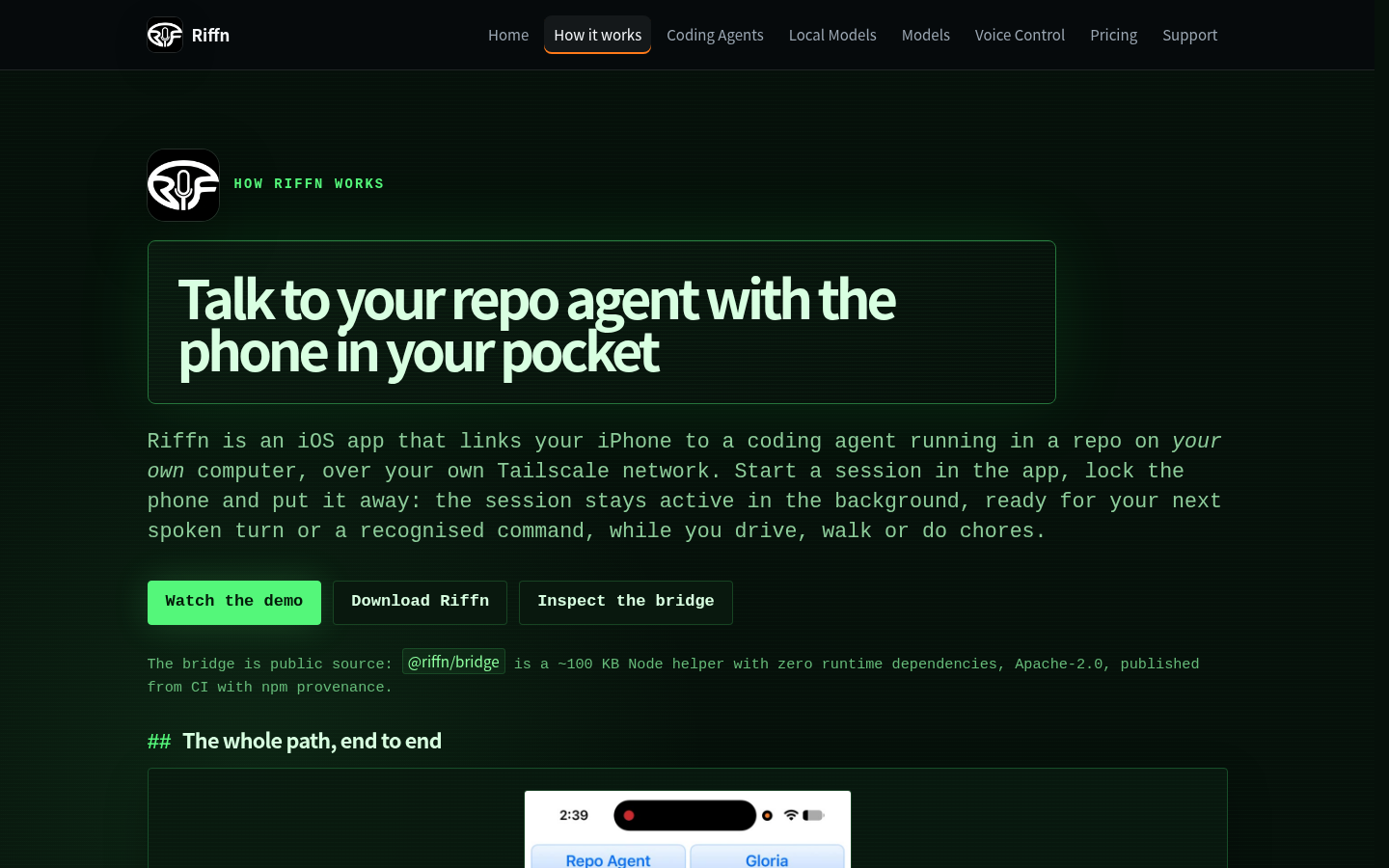
A Show HN post is not a funded product launch with a marketing team behind it. It's a developer putting a working project in front of Hacker News' technical readers for direct, often blunt, feedback. The title carries the entire pitch: an "instant voice link" between the person talking and two different kinds of backend — agents hosted in the cloud, and models running locally on the user's own machine. Riffn's own how-it-works page, published at the URL it lists for that purpose, is the primary source this article draws on, and no other outlet or third-party account has been checked against it.
What matters isn't any single project like this one. Small voice-to-agent bridge tools surface on Show HN on a regular basis. What matters is the pattern behind them: developers keep building thin connector layers like Riffn because the agent runtimes and hosting platforms they already use don't give them voice-native access out of the box. Every project in this shape is a signal about a gap in the stack, and that gap is the more durable thing to pay attention to — not the specific weekend project that happens to fill it today.
The detail
For a reader meeting Riffn for the first time, the name and framing already tell you which category it sits in: a voice interface layer positioned between you and two structurally different backends — hosted AI agents, and locally run models. That split is the interesting engineering claim. Bridging to one cloud API is a solved problem; handling both a network round trip to a hosted agent and a local inference call from the same voice interface means juggling two very different latency, privacy, and reliability profiles inside one tool.
Beyond that framing, no specifications, pricing, install requirements, or platform support for Riffn have been verified for this article, so none are stated here. What's checkable right now is that the post exists, that it's framed as a public, community-facing project rather than a commercial release, and that it targets people who already run their own agent or local-model setup.
If what actually pulled you toward this story is the ai-tools category more broadly — voice interfaces, agent orchestration, local-model tooling — treat this post as one data point rather than the whole picture. The ai-tools buying guide is built for comparing that category properly, across more than one Show HN thread at a time.
Once you move past "what is it" and into "what would I actually build or host this kind of thing on," the infrastructure question shows up fast. A voice-to-agent bridge is a live, latency-sensitive service once it leaves a laptop, and it needs somewhere dependable to run. Check current price for Vercel Enterprise to see exactly which support tiers and compliance controls change once a project like this moves from a personal demo to something a company depends on.
What it means for you
If you're a solo developer poking at a tool like Riffn on your own machine, none of this changes your workflow yet. You're evaluating locally, and the hosting decision comes later, if it comes at all. Skip the infrastructure question entirely until you have something worth putting in front of other people.
If you're the person who'd actually be asked to put a voice-agent bridge in front of real users or a real team, the calculus is different. The choice in front of you isn't whether to try a tool shaped like Riffn — it's what that tool runs on once it stops being a demo and starts being infrastructure someone else depends on.
| Deciding factor | Matters more if... |
|---|---|
| Team size on the agent pipeline | More than a handful of people depend on it staying up |
| Data-handling or compliance requirements | Voice or agent data passes through a regulated workflow |
| Support response expectations | A broken voice link blocks a live product, not a side project |
| Deployment scale | You're running this across several environments, not one |
None of those factors are specific to Riffn. They apply to any AI-agent tooling you decide to run somewhere other than your own laptop. See current pricing at the merchant to see where your own usage actually lands before you commit to a hosting tier.
The decision here isn't whether Show HN Riffn is worth reading about — it clearly caught enough attention to be worth this page. The decision is whether you're still in the watching-Show-HN stage or the now-I-need-infrastructure-that-won't-fall-over stage. Answer that honestly before you pick a plan.
What this costs right now
Vercel Enterprise
Vercel
The last check on this price fell outside our freshness window, so no figure is shown.
Check the current price at VercelPrices move. We print the figure we read and the moment we read it, and suppress anything older than its window rather than guess at the current number.
Evidence held
What this page is built on. Every figure above traces to one of these records, with the time it was taken.