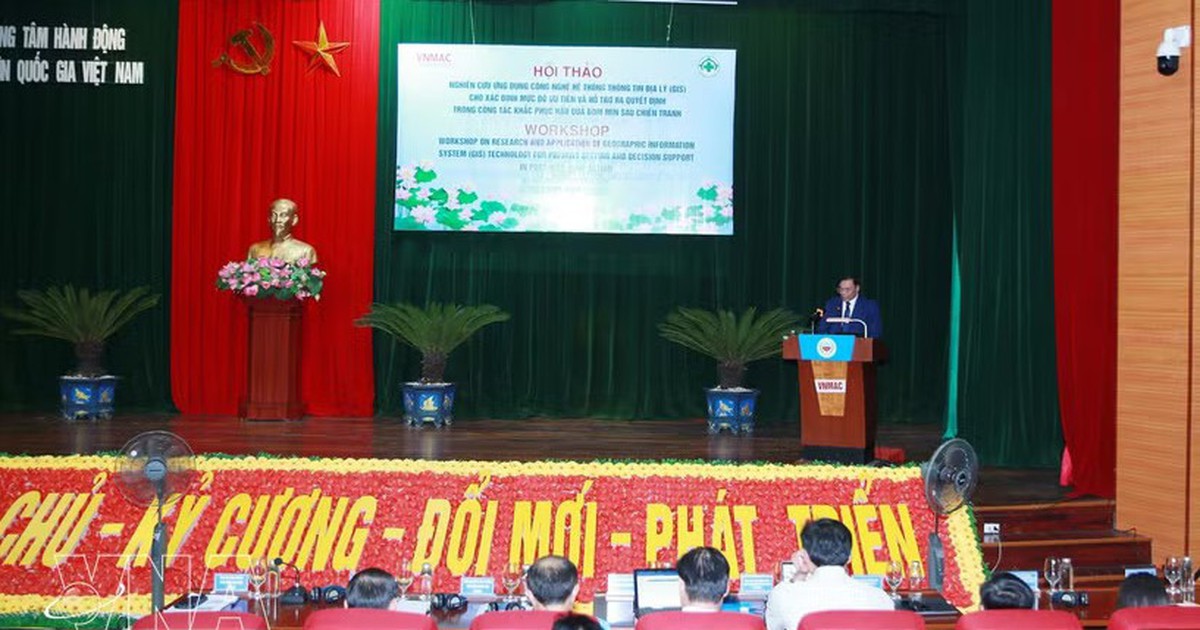
Vietnam uses GIS for priority setting in post-war bomb, mine clearance
The workshop was co-organised by the Vietnam National Mine Action Centre (VNMAC) and Norwegian People’s Aid (NPA).
 Spots
Spots The workshop was co-organised by the Vietnam National Mine Action Centre (VNMAC) and Norwegian People’s Aid (NPA).

The study combines wartime bombing data, field survey results, population density, land-use planning and other socio-economic factors to develop priority maps.
It demonstrates the potential of GIS to improve the efficiency of efforts to address the consequences of bombs, landmines and unexploded ordnance (UXO) in Vietnam.
Ha Dinh Huong, standing deputy director general of VNMAC, said that although the war ended decades ago, remnants of bombs, mines and other explosive materials remain a major challenge to public safety and sustainable socio-economic development in many localities.
The Party and state, particularly the Ministry of National Defence, have paid close attention to the issue, maximising resources and working closely with international organisations to accelerate the clearance of contaminated land, he said.
Huong noted that the identification of areas requiring UXO clearance previously relied mainly on maps of suspected contaminated areas (BMA) produced through broad-area surveys. However, the suspected contaminated area is vast while financial, human and equipment resources remain limited.
Therefore, relying solely on contamination data may not ensure that resources are allocated in line with the urgent development needs of individual localities. Mine-action managers need scientific tools to convert technical data into practical decisions, he said.
Facing that fact, VNMAC, in coordination with NPA and with funding from the U.S. Government, launched a pilot study in Quang Ngai to develop a GIS-based prioritisation and decision-support method.
The study adopts an approach that integrates multiple data layers instead of assessing only the risks posed by bombs and mines.
The five core criteria consist of bomb and mine density, suspected contaminated areas, population density based on address data, accident-risk hotspots, and land-use changes under the province’s 2021-30 development plan.
The workshop was co-organised by the Vietnam National Mine Action Centre (VNMAC) and Norwegian People’s Aid (NPA).