
Spots

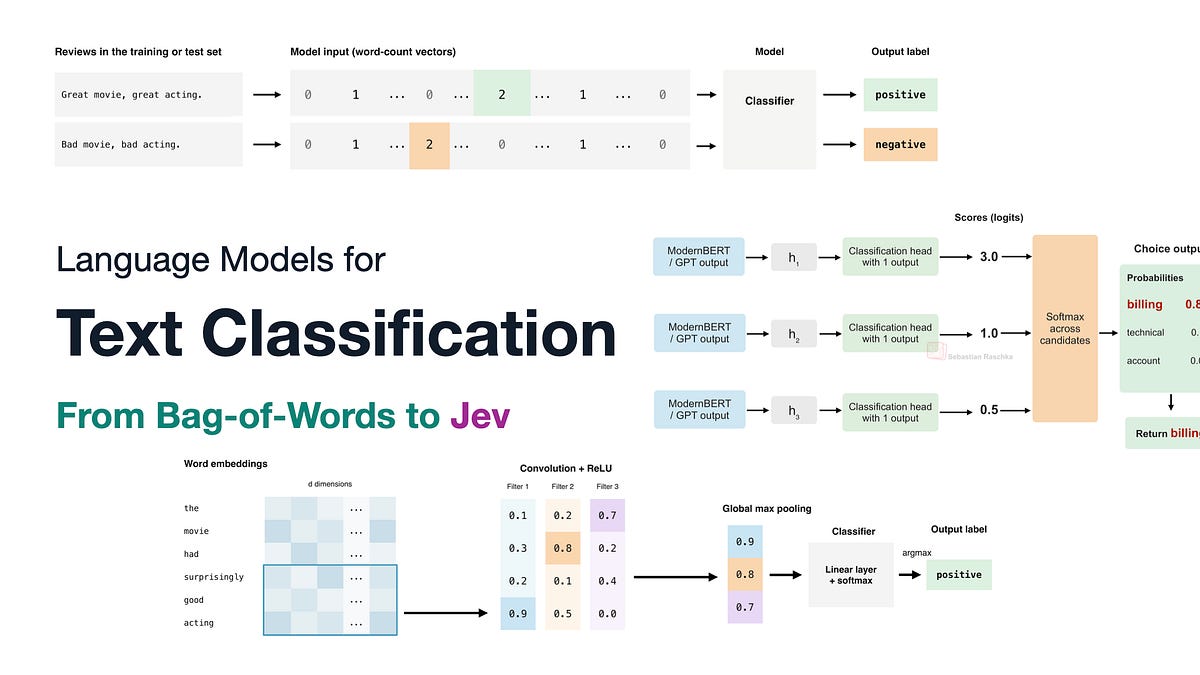
Language Models for Text Classification: From Bag-of-Words to Jev

A Visual Guide to Bag-of-Words, RNNs, CNNs, Transformers, Jev-like APIs, and Calibration The recently released Jev AI model has been quite a cultural phenomenon in technical communities in the past 2 weeks.

While Jev aims to classify things, it’s easy

While Jev aims to classify things, it’s easy to dismiss Jev as “just a classifier,” and my own view of Jev has evolved quite a bit over the past few days. In particular, my thoughts went from “classifiers used to be my bread & butter; I can easily build this myself” (more on this later) to “wow, this actually works better than I thought.”

Sure, the latest state-of-the-art GPT and open-weight LLMs

Sure, the latest state-of-the-art GPT and open-weight LLMs can do the same kinds of classification tasks as Jev, while also being capable of much more general decision-making. But Jev’s advantage is that it can handle those classification tasks much faster and more cheaply.

At the other end of the spectrum, for

At the other end of the spectrum, for a narrow, well-defined problem, Jev probably won’t classify anything better, faster, or cheaper than a special-purpose classifier. But its selling point is that it is far more general than those task-specific models.

So, what is the methodology behind Jev (based

So, what is the methodology behind Jev (based on an educated guess), what can it do, and why is it so popular? I aim to answer all of these later in this article. However, I thought starting with a brief history of language models for decision-making would be a great way to begin. And it hopefully helps demystify some of the hype and show what Jev does very well (”Jev is essentially a text classifier,” but “Jev is also not ‘just’ a text classifier.”)

PS: I am not affiliated with Jev in

PS: I am not affiliated with Jev in any way. Also, I am not offered free access to Jev, and this is also not a product endorsement, just a technical article to offer some insights into the history of text classification to help you make sense of the recent hype.

Since this is a long article, I recommend

Since this is a long article, I recommend reading it in your browser, where you can access the table of contents menu on the left side. 1. Language modeling and classification in the pre-transformer era

For completeness, before we put Jev in context

For completeness, before we put Jev in context (no pun intended), I thought it made the most sense to start chronologically. In this section, I want to take a brief tour of applied text classification via naive Bayes, logistic regression, and the more classic (deep) neural networks before transformer-based models came along. 1.1 Bag-of-words: naive Bayes, logistic regression, and XGBoost

Back in the day, when I was a

Back in the day, when I was a grad student 15 years ago, even though recurrent neural networks already existed (more on that later), text classification was usually done with a bag-of-words representation because it was straightforward and could get good results on moderately sized datasets.

In short, we can think of the bag-of-words

In short, we can think of the bag-of-words representation as a method that makes free-form text input of different lengths compatible with classic classifiers (naive Bayes, Logistic Regression, SVMs, Random Forest, XGBoost, to name a few), which expect a fixed-size input vector.

News

Language Models for Text Classification: From Bag-of-Words to Jev

A Visual Guide to Bag-of-Words, RNNs, CNNs, Transformers, Jev-like APIs, and Calibration The recently released Jev AI model has been quite a cultural phenomenon in technical communities in the past 2 weeks.

@spots
Source: Hacker News
See more like this